This past Sunday I met with Chelsea's aunt,
Mona, who was a world class marathoner back in the 80's and is still quite the running enthusiast. As much as Chelsea warned me
"she can be a bit intense," she could not have been more perfect! She grabbed the camera, took us out on the road, and kept yelling out directions while we ran up and down the road. She made
a lot of good suggestions for run training in general, but also picked out
a few form tips that will be hugely helpful.
Since this is going to be long, I'll jump right in. Here is what I learned.
1. 10 Percent Rule
Mileage from week to week should only be increased 10%. For example, if you ran 20 miles this week and are looking to increase your mileage, you should run no more than 22 miles (10% greater than 20 miles) this coming week. I had read about this rule in Dean's book 50/50 and then heard it again from Chelsea's aunt. I guess it has some grounds.
2. Hard-Easy, Hard-Easy...
The idea here is to
follow every hard run day with an easy run or rest day. This will allow your body to recover no matter whether the hard run was speed work, hills, or just a difficult pacing. My own runs have been pretty similar; I'll run 3-5 miles every day at very similar speeds. So from now on I will attempt to not only mix up distances, but also alternate intensities to allow myself better recovery and hopefully avoid injury.
3. No speed work until 25+ miles/week easy
This I was a bit surprised at initially, but it makes sense. Speed work requires a lot of very fast muscle movements and a lot of quick energy. If your muscles (and ligaments/tendons) are not prepared for it, you could do a lot of damage.
Therefore, let your body get used to more endurance first and then work in the speed. I have the exact same approach in swim training, so it only makes sense to follow the same guideline in other sports (including cycling!).
4. Your hands (and arms) should not cross your body
The rule of thumb is that
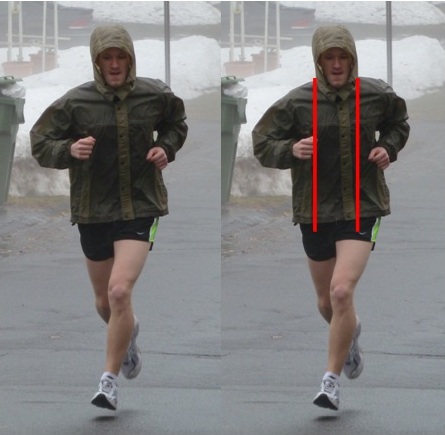
your hands should never cross your body further than your nipples; that's as far as they go! If your arms cross, then your upper body wants to twist more. If your upper body twists while your legs are trying to run straight, then your legs are not only working to push forward, but also working to attempt correcting the twist your upper body is creating. This added torsion on the lower body can really cause some damage in your legs, not to mention waste energy.
With the inserted lines on the right, you can tell how far across my hands/arms are allowed to go. Since the camera has a bit of an angle, my right hand may be slightly over the line, but overall I do pretty well to stick to this rule already.
5. I carry my shoulders
Here's my first critique. This is the first and most prominent thing that was pointed out to me.
Looking at the picture on the left, I look normal, right? Wrong. As Mona pointed out (and I indicated with lines on the right), you shoulders should be even (yellow line). However, if you draw a line through both of my shoulders in that picture (red line), I am obviously carrying my left shoulder relative to my right. This means I have a good amount of tension in my shoulders, upper back, chest, and arms which is wasting energy that could be saved for later. I've noticed that my arms can get tense and my back gets very stiff after running for awhile, so this was already on my list of things to work on, but now I've seen it in pictures.
6. I "pop" due to my upper body tension
Because of all that upper body tension,
I "pop" (move up and down) when I run. We did some drills letting our arms relax completely while we ran. As awkward as it felt and as funny as it must have looked, I actually stopped bobbing up and down. If I can stop "popping" (vertical movement), then I have that much more energy to put into horizontal movement.
7. My footstrike is generally very good
I was very happy to hear (and see) that my footstrike - in general - is very good. You can never be guaranteed, but this at least takes my footstrike off the list of issues related to my shin splints. The strike - as Mona tells us - should not be the ball of your foot or the heel,
it should be just behind the ball and just in front of the middle of the foot.
On the right, I've indicated the three most common places to strike your foot, the heel, the midfoot, and the ball. The heel and ball are in red (places you shouldn't be hitting first). As I mentioned, the midfoot position (green) is just behind the ball of your foot. On the left, I've circled three places on the body, the hip, knee, and foot strike position. Pretend that there is also a circle on the shoulder (beyond the frame of the picture). Drawing a line through these points should give you a close to vertical line. Mine is obviously slightly off, but in general is still good; you do not want the knee and foot any further out from the body than that when striking the ground.
8. I have a slight under pronation
Despite the good foot strike,
I have a slight under pronation. (Runner's World has a great explanation of pronation
HERE). I'm told that it is quite natural and as long as it doesn't cause my pain or any discomfort I should be fine, but in theory it does cause some added stress on my legs, so this is something I could certainly work on.
As you can see, a normal protonation (in yellow) would have me landing flat with my foot. However, as the red line indicates, I am landing with the outside of my foot first. This is not the case at all times (I do strike even at times as well), but this is my tendency.
9. I have a good kick back
When you run, the
power should be coming from the leg moving backwards. Your foot hits the ground directly underneath your body and should propel you forward by pushing backwards instead of having the foot strike ahead of you and pulling your body ahead.
Here's a picture of my kickback. On the right, I highlighted the position of the hip, knee, ankle, and toes relative to one another. As you increase speed, you should notice that relative to this position shown, the knee will move slightly back, the heel will come further up towards your butt, and the toes will be more in a plantar flexed position due to the force you're using to push off the ground.
10. Hills = higher RPM, shorter stride, lean back
No matter which direction you're going, uphill or downhill,
your stride length should decrease, your rpms should increase, and you have to focus on keeping your posture up which means most people have to feel like they are leaning back.
On the uphill, many people want to maintain their stride length and muscle through it. Those athletes will waste energy, increase their heartrate and breathing, and fatigue faster. You want to maintain your heart rate and breathing by increasing your rpm and shortening your stride. Once you hit flat ground again, widen that stride back out and start picking off the runners who are now fatiguing.
On the downhill, it is temping to let your stride lengthen and allow gravity to pull you down the hill. I've certainly done it! Remember the Run For Nancy's Children 5K, post
HERE? The third mile of that course had two steep downhills and I let loose hitting a 5:54 mile with an incredibly long stride the whole way. The issues here are two-fold. In the short run, by lengthening your stride you are putting your foot strike position ahead of you and most likely hitting heel first. The forward (or heel) foot strike is acting as a brake which you then have to overcome by using your own energy - that's not efficient! In the long-term, by heel-striking on a downhill, you are putting MUCH more stress on your knees, hips, back, and whole body in general. I'm sure after one race last fall I will never see an affect on my body, but if I did that on every hill I ever run, I'm going to blow my knee or hip out. Instead, just like on the trip uphill, you should be keeping your stride short which helps keep stress off of your joints and increase your rpm in order to keep up with the speed. You should also be maintaining your vertical posture.

Here, I have a circle at my hip and an imaginary circle at my shoulder (out of frame). The yellow line is a straight vertical and should be where your posture is at. The red line connects my hips and shoulders. And here, where I am still slightly off of a vertical posture, I very much feel like I am leaning backwards already. This picture was taken after much prompting, so my "normal" posture is far more forward than this on the downhill.
11. Warm up!!
Plenty of
studies have shown that pre-workout stretching has no benefit. That doesn't mean warming up doesn't.
By warming up your muscles, you are loosening up the tension and waking the fibers up before you thrash them around for the next hour or more on a run. One thing I am bad at making a habit is warming up. I've had my reservations about blaming it for my shin splints, but after asking about it, I was told that it is very likely that stiff/tight calves and thighs could be the reason my shins are being torn apart.
12. I have super strong legs
Despite all the small (and large) negatives about my running, Mona told me one thing;
"your legs are going to make it hard for you to correct these things." I thought that was a bit of an odd statement, but she continued by saying "Your legs are so strong that the energy you lose in your upper body is taken care of by your legs." In the end, I have great legs for running, but I could be getting much more out of them if I learned to not waste energy elsewhere.
Picture from the half marathon.
Apparently these "beasts" are both a huge asset and a major hurdle. Who knew?!
TMB, maybe instead of being challenging rivals we should start a club (or support group) for those whose athletic ability hinders it's own progress. haha What do you think?
13. Strengthen the muscles in the front of your calf
For someone like myself who has issues with shin splints,
it is important to keep your calves and hamstrings as loose as possible, but also to
strengthen the muscles in your shin. To do this, simply pull up with your foot (dorsal flexion), release, and repeat. Many people do this with light body bands as well for a bit of resistance or more weight depending on your ability. For myself, it seems that the battle between my calves and my shin muscles is a one-sided fight, so I have to try and build up those muscles so that I avoid future shin issues.
And that is what I learned last Sunday. And as of today, I have stretch bands, so I will start my daily regiment of building up those Tibialis Anterior muscles!
Questions
1. Do you have any other running tips to add yourself?
I'm sure the list could go on forever if we really wanted it to.
2. Do you follow the 10% rule?
While I find that it makes complete sense, I find it hard to believe that it is followed often.
3. Have you ever taken photos or video of your running for analysis?
I've done it a lot with swimming, but his is the first time I've done it with running. I would like to make it a habit though. Seeing the pictures really makes a lot of difference in how you mental assess technique.
Stay fit. Stay healthy.