
One of my goals through this fitness journey is to share and learn from my own injury experiences, hopefully enabling others to avoid or at least recover from similar incidents. Today's topic is...
Runner's Knee
What is Runner's Knee?
Runner's knee is of course a common injury to runners. It is much like swimmer's shoulder and tennis elbow in that it is an injury of overuse; while swimmer's roll their shoulders repetitively, runner's bend their knee almost non-stop. Typically, pain is felt on the lateral (outside) side of the knee and can be localized to the knee alone or may radiate a bit above and below the knee. You may feel tightness in this area prior to the onset of pain and generally most symptoms lesson or even disappear once you stop running.
Is Runner's Knee an impact issue in the knee?
No, the impact your knee suffers during running can cause other injuries. Runner's Knee only involves the knee in it's localization, but more directly corresponds to effects of the Iliotibial Band, ITB.
What is the ITB?
The ITB, or iliotibial band/tract, is fibrous connective tissue that reinforces the deep tissue of your thigh and provides attachments for the gluteus maximus (your largest butt muscle) and the tensor fasciae latae (a hip abductor muscle). The band stretches from the hip down to just below the knee.
Just above the point where the ITB connects to the tibia (shin bone), it extends over the end of the femur (thigh bone), technically the Lateral Epicondyle.
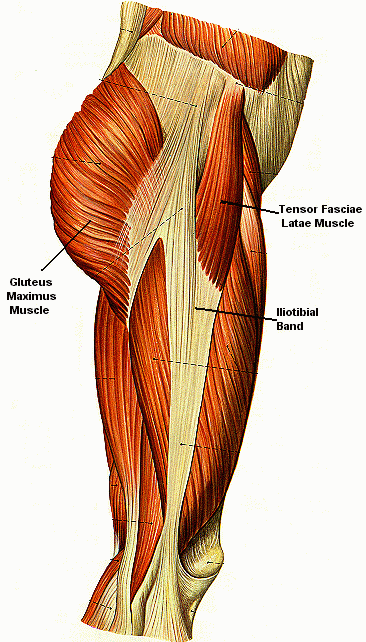
 |
| Source |
When you bend your knee, the ITB moves from the front of the lateral epicondyte to the back creating friction.
 |
| Source |
Tightness in the ITB can also leave you more prone to acquiring Runner's Knee. Therefore, it is important to maintain flexibility. Other factors that lead to increased susceptibility are over pronation, uneven running surface, and differences in leg length.
Prevention
As we know, centuries of humans have run without acquiring this injury, so it's not inevitable; it is in fact avoidable. The three main causes of Runner's Knee are increasing running volume too fast, a tight ITB and poor running form.
Increasing Volume
Most people's bodies are not conditioned to running marathons. It takes time to get up to that much. As much as we think of conditioning our muscles and our cardiovascular system, it is just as important if not more to consider our connective tissue. The ITB and connective tissue surrounding the lateral epicondyte need time to build up their threshold for the friction caused by running a marathon. This is one more important reason why everyone should ease into an exercise or training schedule.
Tight ITB
If your ITB is more tight than normal, the friction is causes on the lateral epicondyte will increase. In order to release some of that tension, you can use the following stretches.

Standing ITB stretch. While standing, move one leg behind the other and lean towards that leg. You should feel the stretch between your hip and knee.

While lying down, wrap a band around the midfoot. Cross each end of the band around the outside of your ankle and pull towards you keeping your knee straight.
 |
| Source |
While standing, swing your leg side to side comfortably. Allow your range of flexibility to determine how far your leg reaches. You can also try swinging your leg back and forth though this targets the hip joint.
A foam roller is also a popular way to both massage and stretch various muscles and connective tissues including the ITB. You can find them for around $10-30.
You may also benefit from glute stretches since this muscle is attached to the ITB and can be a cause of increased tension. Below is my personal favorite glute stretch. While lying, place your legs as shown. While pulling up on the bottom leg, push back with the upper leg. Use your arms for support and balance, but no more than 5% of the pressure.
 |
| Source |
Treatment
As with most running injuries, R.I.C.E. is the best first step treatment (Rest, Ice, Compression, and Elevate). The rest keeps you from further tightening the ITB. Ice limits the inflammation of the connective tissue. Compression keeps this tissue in place allowing for faster recovery. Elevation promotes healthy bloodflow.
After immediate treatment, you can stretch to release tension on the ITB. This can have a great effect!
Another method for treating Runner's Knee while still running, is using a knee strap which puts pressure on the leg both above and below the knee. This is meant to release tension on the ITB. I, however, am not sure I see how this is supposed to work.
My Story
As you've noticed, I've been complaining of a bit of tension in my right leg lately. It started about two weeks ago. It was on the outside of my knee and slightly higher up, but radiated to just below the knee at times as well. At the time I figured I just needed to stretch my leg out, so I ignored it and kept to my training schedule.
A few days passed and on the 2nd of April I went out for my long run, 6 miles. As I explained HERE, I made it through four of my six miles before I had to call for a ride. That was certainly a low point of my training, but I was happy to have had my phone on me (by far a rare event).
At that point I really tried to sit down and I poked and proded my leg to figure out what was tight, where it was and what might help relax it. I talked to a friend who is a massage therapist and she confirmed my suspicion; it was my ITB. I used some heat and the pain went away, but it returned when I ran.
I hope this is injury review has been helpful!!
Questions
1. Have you had Runner's Knee or similar pains? What did you do?Stretching and faster paced running has seemed to be the most effective for my pain.
2. When you go outdoors to exercise, do you carry identification, a cell phone, emergency info? How so?
I've tried pouches, backpacks, and carrying by hand and nothing ends without cramps or extensive chafing. Any suggestions?
3. Is stretching a part of your regular routine?
It used to be a part of mine and now will be yet again.
Stay fit. Stay healthy.

