Showing posts with label runner's injury. Show all posts

Tuesday, May 10, 2011

Blog M.D. - Diagnose My Injury

Ok all you doctor wannabes!  Time for another installment of...

Blog M.D. - Diagnose my Injury 
(aka, diagnose my injury so I don't have to spend time or money going to the doctor).

Are all of our contestants ready?

Alright.  Today's clue is...

Foot pain

We'll take a short break while you consider how much you want to wager.

Press play button for interlude music


Ok.  It's time to give you a little more info.  Let's look behind door number 1.

Door #1
Hi.  I'm a 25 year old triathlete and I am experiencing a pain on the inside of my foot.  I have a slight underpronation.  About a week ago, I began feeling a pain on the top of my foot along the bones for my big toe.  My big toe would also go numb at times.  I thought it was my shoes just being too tight, so I loosened them.  That helped the numbness, but not the pain.  Now, I have a pain on the inside of my foot even while walking around the apartment.  I'm not sure if it's the same pain just expanded, moved, or changed or if it's something completely different. 

Any hypotheses, guesses, or stabs in the dark?

Let's then move onto door number 2.

Door #2
My recent weekly mileage is posted on the left sidebar and my daily workouts are posted on DailyMile.  I've stuck to under 20 miles per week recently, however, this past week I cut back to only three runs and increased the distance of each.  My long run on Saturday was 9 miles.  For me, that's three miles longer than anything I've done in a couple weeks.  The run felt great though, so I'm not sure it had any cause. I also spent some time yesterday barefoot.  I had a dance program in the afternoon that I did without shoes.  Do you think I mess myself up by jumping around barefoot for an hour?

Any thoughts?

Ok, our final door, door number 3.

Door #3
....A New Car!!!!

Ok, not really (though I could use one).  I did a bit of research myself and I doubt it's plantar fasciitis since that is swelling at the bottom of the foot and my pain is on the inside (and top early on).  My best guess at this point in time is inflammation of the posterior tibialis tendon due to increased mileage but moreso my barefoot stint.  The Q & A HERE from Running Times Magazine is the best fit I've found and it tells me to ice the foot and try various exercises like picking things up with my toes (swimmers are really good at that, so I already do that a lot). 

And let me tell you, trying to focus and write a blot entry while ignoring the feeling/pain of an ice pack applied to your foot is incredibly difficult!!!  I'd like to see THAT on "Minute to Win It."


Ok, now it's time for you to write down your answers; preferably in the comment box below or in an email.  Once you've done so, we'll open the phone lines to let America vote on who will be our next Blog M.D. 

Thanks for playing.  We'll see you next time on Blog M.D. - Diagnose My Injury.  (It even rhymes!)

-------------------------------------------------------------------------------------------------------------------------

Normally I would give myself a couple weeks before freaking out about a new injury, but I was really hoping to up my workouts this week, so this bummed me out something fierce!  Any ideas or thought would be helpful.  Thanks!

Stay fit.  Stay healthy. 

Monday, April 11, 2011

Runner's Knee

One of my goals through this fitness journey is to share and learn from my own injury experiences, hopefully enabling others to avoid or at least recover from similar incidents.  Today's topic is...

Runner's Knee


What is Runner's Knee?
Runner's knee is of course a common injury to runners.  It is much like swimmer's shoulder and tennis elbow in that it is an injury of overuse; while swimmer's roll their shoulders repetitively, runner's bend their knee almost non-stop.  Typically, pain is felt on the lateral (outside) side of the knee and can be localized to the knee alone or may radiate a bit above and below the knee.  You may feel tightness in this area prior to the onset of pain and generally most symptoms lesson or even disappear once you stop running. 

Is Runner's Knee an impact issue in the knee?
No, the impact your knee suffers during running can cause other injuries.  Runner's Knee only involves the knee in it's localization, but more directly corresponds to effects of the Iliotibial Band, ITB.

What is the ITB?

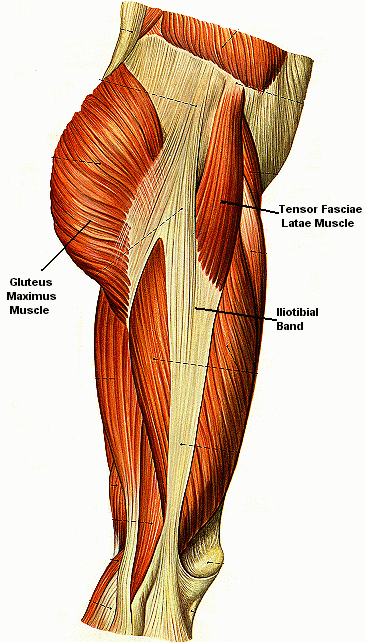
The ITB, or iliotibial band/tract, is fibrous connective tissue that reinforces the deep tissue of your thigh and provides attachments for the gluteus maximus (your largest butt muscle) and the tensor fasciae latae (a hip abductor muscle).  The band stretches from the hip down to just below the knee.

Just above the point where the ITB connects to the tibia (shin bone), it extends over the end of the femur (thigh bone), technically the Lateral Epicondyle. 


Source

When you bend your knee, the ITB moves from the front of the lateral epicondyte to the back creating friction. 

Source
Runner's Knee is the irritation of the femur's connective tissue via friction with the ITB due to prolonged and repetitive bending of the knee.

Tightness in the ITB can also leave you more prone to acquiring Runner's Knee.  Therefore, it is important to maintain flexibility.  Other factors that lead to increased susceptibility are over pronation, uneven running surface, and differences in leg length.

Prevention
As we know, centuries of humans have run without acquiring this injury, so it's not inevitable; it is in fact avoidable.  The three main causes of Runner's Knee are increasing running volume too fast, a tight ITB and poor running form.

Increasing Volume
Most people's bodies are not conditioned to running marathons.  It takes time to get up to that much.  As much as we think of conditioning our muscles and our cardiovascular system, it is just as important if not more to consider our connective tissue.  The ITB and connective tissue surrounding the lateral epicondyte need time to build up their threshold for the friction caused by running a marathon.  This is one more important reason why everyone should ease into an exercise or training schedule. 

Tight ITB
If your ITB is more tight than normal, the friction is causes on the lateral epicondyte will increase.  In order to release some of that tension, you can use the following stretches.


Standing ITB stretch.  While standing, move one leg behind the other and lean towards that leg.  You should feel the stretch between your hip and knee.


While lying down, wrap a band around the midfoot.  Cross each end of the band around the outside of your ankle and pull towards you keeping your knee straight.


Source


While standing, swing your leg side to side comfortably.  Allow your range of flexibility to determine how far your leg reaches.  You can also try swinging your leg back and forth though this targets the hip joint. 


A foam roller is also a popular way to both massage and stretch various muscles and connective tissues including the ITB.  You can find them for around $10-30.

You may also benefit from glute stretches since this muscle is attached to the ITB and can be a cause of increased tension.  Below is my personal favorite glute stretch.  While lying, place your legs as shown.  While pulling up on the bottom leg, push back with the upper leg.  Use your arms for support and balance, but no more than 5% of the pressure. 

Source

Treatment
As with most running injuries, R.I.C.E. is the best first step treatment (Rest, Ice, Compression, and Elevate).  The rest keeps you from further tightening the ITB.  Ice limits the inflammation of the connective tissue.  Compression keeps this tissue in place allowing for faster recovery.  Elevation promotes healthy bloodflow.

After immediate treatment, you can stretch to release tension on the ITB.  This can have a great effect!

Another method for treating Runner's Knee while still running, is using a knee strap which puts pressure on the leg both above and below the knee.  This is meant to release tension on the ITB.  I, however, am not sure I see how this is supposed to work. 

My Story

As you've noticed, I've been complaining of a bit of tension in my right leg lately.  It started about two weeks ago.  It was on the outside of my knee and slightly higher up, but radiated to just below the knee at times as well.  At the time I figured I just needed to stretch my leg out, so I ignored it and kept to my training schedule. 

A few days passed and on the 2nd of April I went out for my long run, 6 miles.  As I explained HERE, I made it through four of my six miles before I had to call for a ride.  That was certainly a low point of my training, but I was happy to have had my phone on me (by far a rare event). 

At that point I really tried to sit down and I poked and proded my leg to figure out what was tight, where it was and what might help relax it.  I talked to a friend who is a massage therapist and she confirmed my suspicion; it was my ITB.  I used some heat and the pain went away, but it returned when I ran.

Last night I started doing the above stretches and this morning my leg felt brand new.  I felt a slight amount of tightness on today's 3 miler, but nothing like the last two weeks.


I hope this is injury review has been helpful!!


Questions
1.  Have you had Runner's Knee or similar pains?  What did you do?
Stretching and faster paced running has seemed to be the most effective for my pain.

2.  When you go outdoors to exercise, do you carry identification, a cell phone, emergency info?  How so?
I've tried pouches, backpacks, and carrying by hand and nothing ends without cramps or extensive chafing.  Any suggestions? 

3.  Is stretching a part of your regular routine?
It used to be a part of mine and now will be yet again.  


Stay fit.  Stay healthy.